All-in-One Platform to Launch Iconic Products.

7 Successful Kickstarter Campaigns That Validated Demand Before Launch


Kickstarter's countdown clock is a small piece of theater. It ticks down to zero like something dramatic is about to happen, when for most of these seven campaigns the real event already happened weeks or months earlier, in an inbox or a Discord server nobody outside the company ever saw.
A campaign that hits its goal in four minutes already convinced its audience, days or weeks earlier. The campaign page was just where they went to pay.
What Counts as Pre-Launch Validation?
Validation, before a campaign goes live, means someone outside the founder's team put something on the line before the product existed: money, an email address, a spot in a beta group, thirty seconds on a signup form.
It rules out a founder's own confidence, encouraging comments from friends, and internal, unverified market research.
The 7 campaigns below cleared that bar in different ways: GoChess used a Prelaunch.com reservation page, ad-creative tests, and a VIP offer to past backers; BB-777 used a WhatsApp VIP group and three reserved price tiers; Duo used Facebook lead ads to a landing page with an email nurture sequence; AEKE K1 used a higher reservation fee and a moved launch date after weak early numbers; Neon Odyssey used a pre-launch VIP sign-up and Discord community built on an earlier Kickstarter audience; Circular Ring 2 used buyer research, then a month-long reservation, email and WhatsApp push; Looktech used Prelaunch.com reservations with no working prototype.
7 Kickstarter Campaigns at a Glance: Validation & Results
How 7 Kickstarter Campaigns Validated Demand Before Launch
1. GoChess: Price-Tested on Prelaunch.com, Then VIP Pricing for Past Backers
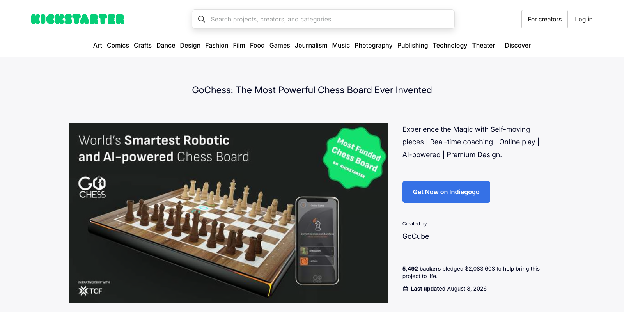
GoChess is an AI-powered robotic chessboard with self-moving pieces and color-coded coaching lights. Particula, the team behind GoCube and GoDice, built it as their third Kickstarter campaign. It launched in May 2023 and raised $2,083,603 from 5,492 backers on Kickstarter, then $4,049,770 from 10,474 backers in total once its Indiegogo InDemand campaign is included.
Before any of that, Particula partnered with Prelaunch.com, a platform for testing demand and collecting refundable reservations before a crowdfunding campaign, to validate the concept and the price point. The validation process surfaced a specific objection: potential customers wanted more detail about the product before committing to a reservation.
TCF, the crowdfunding marketing agency and Kickstarter Premier Partner that managed the campaign, and Prelaunch.com rebuilt the landing page around that feedback, adding deeper technical descriptions of the AI and the self-moving mechanism instead of leaving it vague.
From there, they tested ad creative before launch and found two directions converting best: comparisons to the self-moving Wizard's Chess from Harry Potter, and close-up shots of the pieces in motion.
The close-up visuals alone drove 90% of subscriptions. TCF nurtured every lead who reserved by email, hitting a 67% open rate and a 34% click-through rate, well above typical benchmarks.
They also reached back out to backers from Particula's two earlier campaigns, offering them VIP pricing with no reservation fee, turning past customers into an early source of committed backers and advocates before GoChess ever went live.
2. BB-777: A 2,300-Person WhatsApp Group and Three Reserved Price Tiers
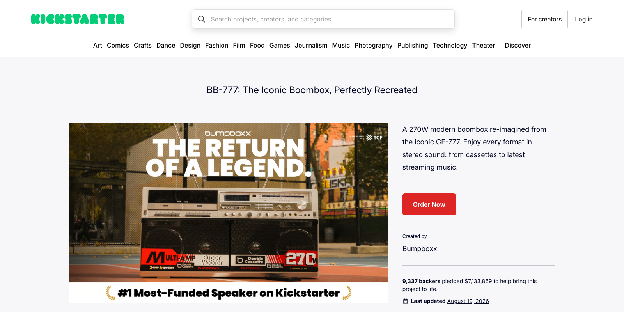
TCF had 1.5 months to prepare BB-777, another TCF-run campaign. BB-777, launched on Kickstarter in March 2026, raised more than $1M in its first hour and $7,133,869 overall on Kickstarter, from 9,337 backers. The product held obvious appeal. The real question was whether an older audience, mostly men in their late 40s and 50s who remembered boomboxes on their shoulders, would pay for one. Almost none of them had backed a Kickstarter campaign before.
TCF tested that question before launch. The team gathered roughly 2,300 of the most engaged fans into a WhatsApp group, shared manufacturing photos, ran daily polls, and offered three reserved price tiers. How many people reserved a spot at each price showed TCF exactly how much real demand existed, before the campaign went live.
TCF also removed a second problem sitting underneath the first: most of these men had never pledged on Kickstarter, and some had never bought anything online through anything other than Amazon. The team walked them through it directly, screenshots of the actual pledge button, a WhatsApp message explaining what a backer count even means, a specialist answering the same account-creation question however many times a day it took.
3. DUO: Facebook Lead Ads Into an Email Nurture List
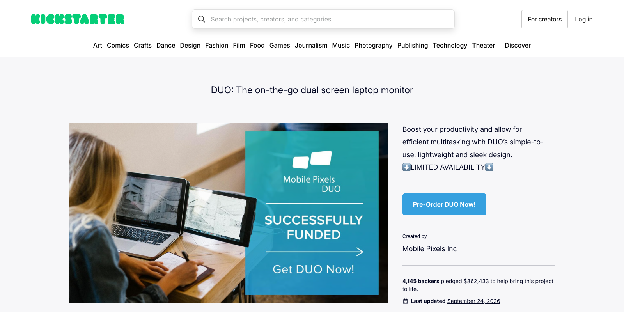
Duo, a dual-screen laptop monitor from Mobile Pixels, launched on Kickstarter in June 2018. It raised $862,433 against a $35,000 goal on Kickstarter, from 4,145 backers, and cleared that goal before most campaigns finish writing their launch-day social posts. Twenty-four hours, to be exact.
Mobile Pixels built a landing page before launch and ran Facebook lead ads on it. Every email address that came in went into a nurture sequence, kept warm until the Kickstarter page finally existed.
The part worth stealing is how cleanly the numbers separate what the pre-launch spend earned from what the launch-day ads earned. Pre-launch ads pulled a 2.5x return on their own, before the campaign existed. Launch-day ads did better, 17x, which rolled the whole thing up to a 4.26x return campaign-wide. Most founders never get to see that split. They see one big number and assume the campaign did the work, when a chunk of it happened while the product page was still sitting in a drafts folder.
4. AEKE K1: A Higher Reservation Fee and a Better Launch Date
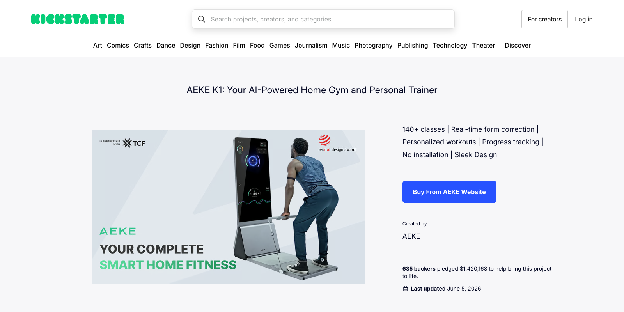
AEKE K1 is a smart home gym that launched on Kickstarter in December 2024 and runs AI-powered strength training, competing against subscription-based rivals with a one-time purchase. A machine nobody has used yet is a hard sell, so AEKE needed proof that real buyers would trust it before committing money to production.
Early prelaunch numbers came in weak. A founder watching those numbers can read them as proof that demand never existed and it lacks readiness for crowdfunding, or as a sign that the implementation has room for improvement. TCF chose the second read and fixed the mechanics before launch day.
Raising the reservation fee cut out casual browsers, leaving only high-intent buyers, and conversion rates on the remaining reservations rose. Moving the launch date to December 5 skipped the Black Friday and Cyber Monday noise and landed in the window where holiday shoppers looked for a premium gift.
AEKE's two fixes traced back to watching prelaunch performance and acting on it before launch day. AEKE K1 raised $1,420,168 from 635 backers on Kickstarter, and $1,524,943 from 678 backers total including Indiegogo InDemand.
5. Neon Odyssey: A VIP Pre-Launch and Discord Built on an Earlier Kickstarter Audience
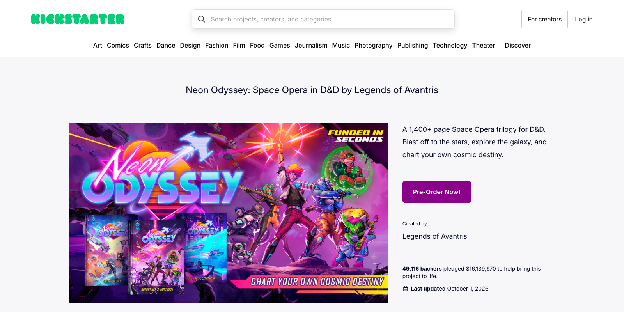
Neon Odyssey launched in May 2026 and raised $16,139,970 against a $60,000 goal on Kickstarter, from 49,116 backers, making it the most funded tabletop role-playing game in crowdfunding history. Avantris Entertainment, the company behind Legends of Avantris, had already done the hard part twice: a first Kickstarter in 2023 for The Crooked Moon, and two years of developing Neon Odyssey before announcing it.
The three months before launch stayed busy. Avantris Entertainment opened a VIP tier that let fans join ahead of the general public, and ran its Discord server as the main gathering point for what co-founder Mikey Gilder called "hype at critical mass." Trailers and setting reveals went out during that window, and fans responded by building their own characters for the game and posting fan art before a single reward tier existed.
Gilder is direct about why this mattered: the pre-launch campaign carries as much weight as the campaign itself, so founders need to plan marketing well before launch and skip the scramble once it goes live.
6. Circular Ring 2: Buyer Research, Then a Month-Long Reservation Push
Circular Ring 2 is a smart ring that tracks sleep, activity, and recovery. It launched on Kickstarter in March 2025. TCF ran the campaign's marketing. Prelaunch.com ran the early research, well before any ad spend. Surveys and buyer signals painted a clear picture of who would want the ring. One finding shaped everything that followed: people wanted to own the ring outright, with no subscription attached.
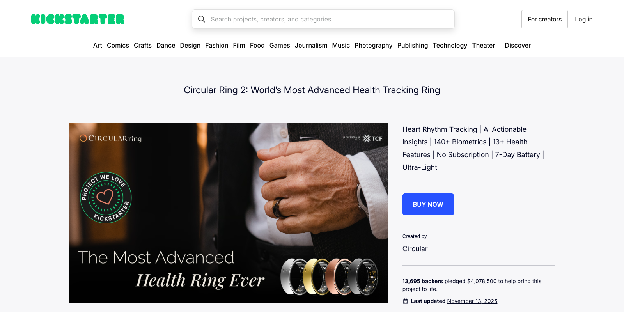
That research fed a month-long pre-launch push that turned cold traffic into a real audience: 2,696 product reservations, 7,486 email subscribers, and more than 1,400 active members in a dedicated WhatsApp group. Separate welcome flows greeted reservation holders and email subscribers, so each group heard messaging tailored to what got them to sign up.
By launch day, that audience was already warm. Circular Ring 2 hit its $700K goal in 4 minutes and crossed $1M within 10 days. By the end of the campaign, it raised $4,078,500 from 13,695 backers on Kickstarter, according to TCF's case study. The backers driving that were people who had already spent a month inside the brand's community before they had the chance to pledge.
7. Looktech AI Glasses: Prelaunch.com Reservations Without a Working Prototype
Looktech launched an AI smart glasses product on Kickstarter in December 2024 with no working prototype, competing directly against glasses already on the market that customers complained were heavy, worked with only one AI model, or required a specific operating system. TCF provided full marketing services: paid ads, PR, influencer partnerships and community building. Looktech positioned itself as the lighter alternative, running both ChatGPT and Gemini side by side.
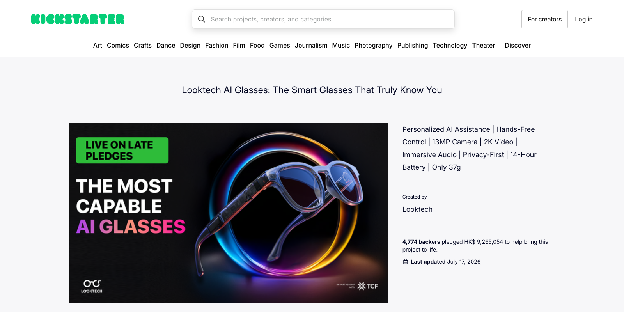
Demand validation ran through Prelaunch.com before production started: 8,500 subscribers, 1,400 reservations, a $3 cost per lead, and a $15 cost per reservation, both comfortably inside industry norms.
Looktech's prelaunch engagement went beyond signups. Reservation holders discussed the product and passed it along to others on their own, turning a subscriber list into something closer to an early community.
Looktech raised HK$9,265,054 (about US$1.19 million) from 4,774 backers on Kickstarter, against a HK$150,000 goal.
Tips for Validating Demand Before Launch
Ask for a refundable deposit, not an email
A free "notify me" signup is weak validation. A refundable deposit is strong validation, and a paid presale is the strongest.
Ask people to pay a fully refundable deposit to hold your best price for when the campaign goes live. Explain on the landing page that the deposit holds that price and that the deal disappears once the campaign starts. Keep the ask small, but treat it as a real payment instead of a simple email signup. Count how many people pay. That number tells you more than any list of email signups, and everyone who pays becomes part of your first group of buyers when the campaign goes live. AEKE K1 raised its reservation fee for this reason, which cut out casual browsers and left high-intent buyers.
Test your price before you set it
Run a few versions of your landing page, each with a different price.
Keep everything else on the page identical, the images, the copy, the layout, so price is the only thing that changes.
Do not pick a winner by conversion rate alone, because a lower price almost always converts better. Compare revenue per visitor for each version: conversion rate multiplied by price. The version with the higher revenue per visitor shows which price the market accepts. On Circular Ring 2, TCF's A/B test found a $239 price outperformed $209 on revenue per visitor, which TCF reports as a 14% revenue boost over the originally planned $209 price.
Run the test for at least a week for meaningful results.
Give your early list a reason to talk to each other
An email list stays silent until you send something.
A group, a Discord server, a Facebook group, or even a comment thread, gives people a reason to show up on their own.
BB-777's team gathered about 2,300 of its most engaged fans into a WhatsApp group with daily polls and manufacturing photos, while Avantris Entertainment used its Discord server as the main gathering point for Neon Odyssey fans.
Post a question about the product once a week, ask which feature people want most, or which color they prefer, and let members answer each other instead of just you.
Reply to every comment in the first few days so the space feels alive.
A list that talks to itself sells to itself once the campaign goes live.
Reuse whatever audience you already have
Check whether you already have any audience: an email list from past orders, a personal social media following, past customers, subscribers from an old newsletter, even a group chat with people who tested an early version of the product.
If you find any, however small, send that group a short personal message a few weeks before launch, tell them the launch date, and ask them to check the page the day it goes live.
A small group of people who already know you converts at a far higher rate than paid ads deliver in the same numbers.
Particula did this before GoChess went live by offering backers from its earlier campaigns VIP pricing with no reservation fee. Avantris Entertainment did it too, bringing the audience from its 2023 Kickstarter for The Crooked Moon to Neon Odyssey.
Find the objection before you find the fans
Reach back into the group you already built for this part: deposit holders, community members, and the audience you already reused. No new audience necessary.
Send them a short survey with one open question: what would make you hesitate to back this.
Write down every answer, even the ones that hurt your feelings. Look for the objection that comes up more than once, price, shipping time, a missing feature, and fix it on the landing page before the campaign goes live.
That happened with GoChess. Prelaunch validation showed potential customers wanted more detail before reserving, so TCF and Prelaunch.com rebuilt the landing page with deeper technical descriptions of the AI and the self-moving mechanism.
Use the exact words respondents used when you write the fix into the copy. A phrase a real person wrote lands harder than a line your copywriter invented (no offense).
Conclusion
A Kickstarter campaign spends real money before it earns any back, on video production, ad spend, inventory deposits, and the weeks a founder gives up to run it. Prelaunch validation turns that spend from a bet into a calculated move, since a founder who already knows people pay for the product spends launch week promoting a sale instead of praying one happens.
Deposits, price tests, community building, audience reuse, and objection surveys all serve the same purpose, turning strangers into a measurable signal before launch day. That signal, the money and attention a founder collects while nothing has shipped yet, ranks among the cheapest and most honest campaigns a campaign gets.
Frequently Asked Questions
What does validating demand before launch mean?
Validating demand before launch means collecting proof that real people want the product before spending money on inventory or a big ad budget. A paid reservation, a presale, or a landing page that converts strangers into a waitlist all count as validation. An opinion from friends or family never counts, because they lack the same instinct to buy that a stranger has when their own money is on the line.
How long should a pre-launch phase last?
Four to eight weeks gives most first-time creators enough time to build a list, run a price test, and collect objections before setting a launch date. Waiting past that window risks starting the pre-launch phase too late to build a real audience before the countdown begins.
Do you need a large following to start?
A large following helps and speeds things up, but it offers no guarantee of success. A small paid list built during the pre-launch window can carry a campaign just as far, since a reservation deposit and a reused existing audience do the early work that a big following would otherwise do.
How much should a reservation fee be?
Tie the fee to your price point instead of picking a flat number. A reasonable target sits between one and five percent of the final price, so a $50 product might ask for $1 to $2, while a $300 product might ask for $10 to $15. The fee stays low enough to keep the ask easy, but high enough to separate a real buyer from a casual browser.
How much does it cost to validate demand before launch?
Costs vary by product and audience. Looktech's Prelaunch.com campaign cost $3 per lead and $15 per reservation. Duo's pre-launch ads returned 2.5x on their own before the campaign went live.
- Title